Voltar
Documentação
Camões Center Quarterly
Título
Camões Center Quarterly
Date
1989
volume
1
number
2
Lista de autores
John Correia-Afonso, Dawit Toga, Ilene Cohn, Lynette Peck
Lista de editores
Mia Turner
Editor
Camões Center for the Portuguese-Speaking World
N.º de capítulo
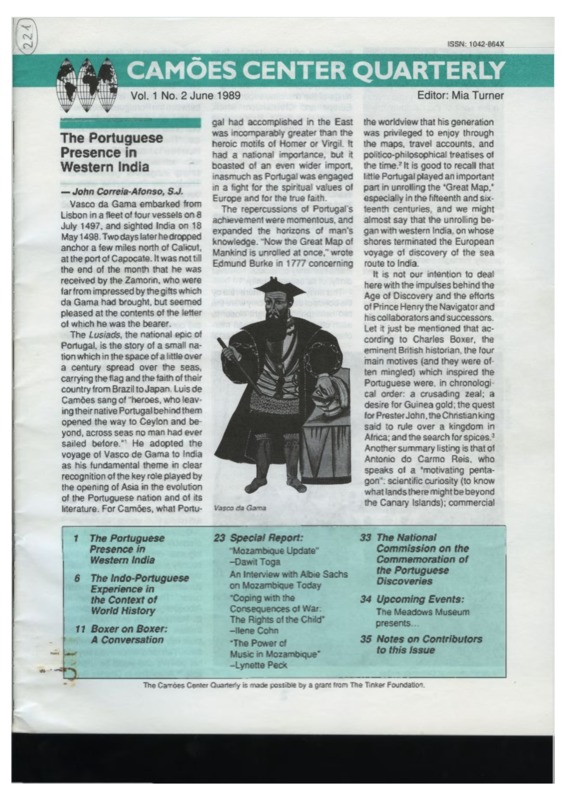
The Portuguese Presence in Western India, The Indo-Portuguese Experience in the Context of World History, Boxer on Boxer: A Conversation, Special Report: "Mozambique Update", An interview with Albie Sachs on Mozambique Today, "Coping with the Consequences of War: The rights of the child", "The Power of Music in Mozambique", The National Commission on the Commermoration of the Portuguese Discoveries, Upcoming Events, Notes on Contributors to this Issue
N.º de páginas
36
Intervalo de páginas
1-35
Cidade
Nova Iorque
content
The Power of Music in Mozambique - Lynette Peck - National unity is not easy to achieve in a country like Mozambique, where hundreds of diverse peoples come together under a single political umbrella. Culture defines community; mere political boundaries are not likely to override communal bonds. But when in 1895 Mozambique was arbitrarily carved out of southeastern Africa, no one thought about the difficult task of building a viable nation in the face of communal segregation. It was not necessary: colonial rule disguised the issue. Fourteen years after independence, however, cultural fragmentation continues to belie the unity which defines “nation.”Today the FRELIMO government is pursuing a new tack in the hope of bridging cultural segregation: the promotion of national music. Joâo Soeiro de Carvalho, a Portuguese graduate student in ethnomusicol- ogy at Columbia University, spoke with me recently about music in Mozambique and its primary role in the struggle for national unity.
Music has long been recognized as a highly effective conductor of social and political processes. Cultures throughout history have used music to bind together their members and maintain the fabric of indigenous traditions. “Music is a tool, a tool to work out social relations and political groupings,” said Carvalho. “It can express a particular ideology, often not explicitly but through symbols that are specific to each language or culture.”
Music has long been recognized as a highly effective conductor of social and political processes. Cultures throughout history have used music to bind together their members and maintain the fabric of indigenous traditions. “Music is a tool, a tool to work out social relations and political groupings,” said Carvalho. “It can express a particular ideology, often not explicitly but through symbols that are specific to each language or culture.”
Date Created
2018-07-19
Creator
Tiago Simões
category
Artigo em revista científica
Country
Estados Unidos da América
Medium
Papel Impresso (preto e branco)
Média