Voltar
Documentação
The New Grove Dictionary of Music and Musicians
Título
The New Grove Dictionary of Music and Musicians
Lista de autores
N.º de capítulo
Marimba
N.º de páginas
3
Intervalo de páginas
681-683
content
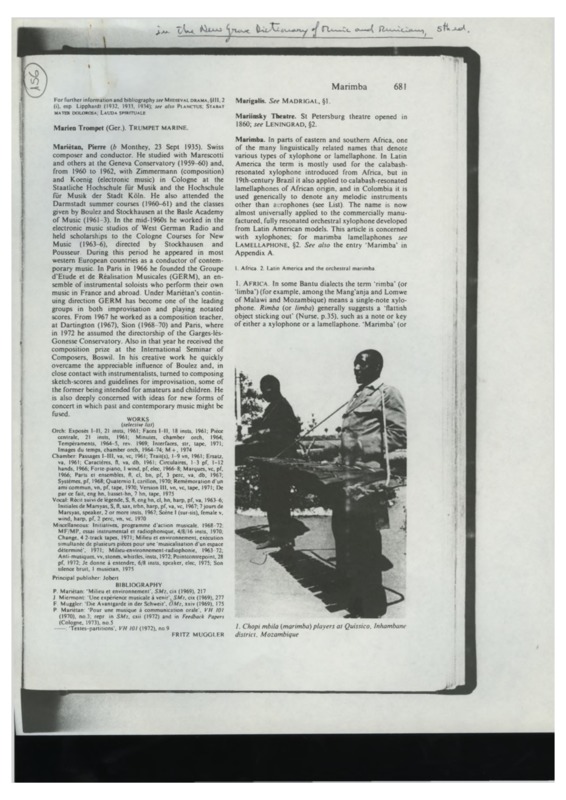
Marimba. In parts of eastern and southern Africa, one of the many linguistically related names that denote various types of xylophone or lamellaphone. In Latin America the term is mostly used for the calabash-resonated xylophone introduced from Africa, but in19th-century Brazil it also applied to calabash-resonated lamellaphones of African origin, and in Colombia it is used generically to denote any melodic instruments other than aerophones. The name is now almost universally applied to the commercially manufactured, fully resonated orchestral xylophone developed from Latin American models. This article is concerned with xylophones; for marimba lamellaphones. Africa. In some Bantu dialects the term ‘rimba’ (or ‘limba’) (for example, among the Mang’anja and Lomwe of Malawi and Mozambique) means a single-note xylophone. Rimba (or limba) generally suggests a ‘flattish object sticking out’ (Nurse, p.35), such as a note or key of either a xylophone or a lamellaphone. ‘Marimba’ (or 'malimba’) is derived from the addition of the Bantu cumulative prefix ma to the stem rimba (or limba, r and/ being the same phoneme in many Bantu languages). 'Marimba' is, therefore, the full instrument, consisting of many rimba (notes). Among the many different Bantu ethnic groups who use such instruments the prefixes can vary according to the nature of noun classes in the languages concerned. Hence the Lozi of Zambia call their xylophones silimba, the Sena of Malawi call theirsvalimba or ulimba, and the Luvale of north-eastern Angola call their two-key instruments jinjimba. Nurse (p.34) maintained that the stem rimba must be closely related to the stem mbira (or mbila) which is also widely used, though only in southern and south-eastern Africa, for both xylophones and lamellaphones, and he suggested metathesis as the reason for this.
The marimba of the Shangana-Ndau people of Mozambique is an example of the calabash-resonated instruments of this area. The calabashes are individually tuned to the pitch of each key and, like many other African instruments, are fitted with a mirliton to modify the timbre: these mirlitons can be made from various types of natural membrane. Tracey (1948) provided a full description of the similar but larger timbila xylophones of the Chopi, neighbours of the Shangana-Ndau. An illustration in Merolla da Sorrarto shows a portable xylophone with calabash resonators from the kingdom of Congo (in northern Angola) called ‘marimba’. He wrote that 'mostly four marimbas are played together’. This practice was exported a little later to the north; such groups of four instruments are still played in southern Cameroon, but there the name 'marimba’ has become obsolete, giving way to the name 'mendzang' (Ngumu, 1976). On the east African coast the instruments associated with the name 'marimba' are quite different from the varieties already described. On the islands of Zanzibar and Pemba and among the Zaramo people of the Tanzanian coast a marimba is a box-resonated xylophone, and in inland Tanzania it is a lamellaphone.
African terminology conflicts with the use of the word ‘marimba’ by Western musicologists during the first half of the 20th century (see Nadel, Husmann and others). Western musicologists developed a ‘marimba stereotype’ with a tendency to call any African xylophone a marimba (but especially those with a portable frame slung around the player’s neck; fig.l) and any
lamellaphone a sansa. This is contrary to the meaning of the terms in African languages. 2. Latin America and the orchestral marimba. The calabash-resonated xylophone may have been introduced to this area in pre-Columbian times (Izikowitz) or by African slaves in later centuries. It was once known in Peru and is still played in Brazil, Ecuador, Nicaragua, Cuba, Mexico (the zapotecano) and Guatemala, where it holds the status of national instrument (fig.2; see GUATEMALA, §11, 1). Here the instrument was further developed by the addition of a second keyboard to give a fully chromatic range. The first of this type were built by Sebastian Hurtado in 1894 and popularized by the famous Hurtado Brothers’ Royal Marimba Band of Guatemala.
The manufacture of the modern marimba (fig.3) as used in the orchestra began in the USA in 1910, the earliest experiments being made by J. C. Deagan and U. G. Leedy. Stopped metal tubes graduated in length served as resonators which for very deep notes were made U-shaped. The vibrating membrane feature was used in certain models (the nadimba, recently revived).
Later experiments included the octarimba (obsolete) in which two narrow bars an octave apart in pitch were arranged side by side, the octaves being struck simultaneously by fork beaters. The marimba became a popular instrument in vaudeville and light ensembles. It was considerably enhanced by Clair Omar Musser, virtuoso and composer, who gave a memorable concert with his 100-piece marimba band in 1935 at Carnegie Hall in New York. With the exception of Percy Grainger, who scored for the marimba and nadimba before 1914 (the suite In a Nutshell), serious composers neglected the marimba until after World War II. Milhaud’s Concerto for marimba and vibraphone (1947), in which the technique of four-hammer playing was exploited, was one of the first postwar compositions to make extensive use of the marimba. The instrument is being increasingly used in the large orchestra. It occurs in Richard Rodney Bennett’s First Symphony, Hartmann’s Eighth Symphony (which includes cadenzas for two marimbas), Messiaen's Chronochromie and Carl Orffs Antigonae. Concertos for marimba and orchestra have been written by several composers, including Robert Kurka, James Basta and Paul Creston.
The compass of the orchestral marimba varies. In general the instrument commences at c and ascends three or more octaves. Bass marimbas reach two octaves below c'. An instrument with an extended compass is occasionally termed XYLORIMBA (see XYLOPHONE). Hard beaters are rarely used on the marimba, as they would damage the slender bars and rob the instrument of its characteristic mellow sound. Music for the instrument is written (usually at actual pitch) in either the treble or bass clef, or at times on a double staff.
The marimba of the Shangana-Ndau people of Mozambique is an example of the calabash-resonated instruments of this area. The calabashes are individually tuned to the pitch of each key and, like many other African instruments, are fitted with a mirliton to modify the timbre: these mirlitons can be made from various types of natural membrane. Tracey (1948) provided a full description of the similar but larger timbila xylophones of the Chopi, neighbours of the Shangana-Ndau. An illustration in Merolla da Sorrarto shows a portable xylophone with calabash resonators from the kingdom of Congo (in northern Angola) called ‘marimba’. He wrote that 'mostly four marimbas are played together’. This practice was exported a little later to the north; such groups of four instruments are still played in southern Cameroon, but there the name 'marimba’ has become obsolete, giving way to the name 'mendzang' (Ngumu, 1976). On the east African coast the instruments associated with the name 'marimba' are quite different from the varieties already described. On the islands of Zanzibar and Pemba and among the Zaramo people of the Tanzanian coast a marimba is a box-resonated xylophone, and in inland Tanzania it is a lamellaphone.
African terminology conflicts with the use of the word ‘marimba’ by Western musicologists during the first half of the 20th century (see Nadel, Husmann and others). Western musicologists developed a ‘marimba stereotype’ with a tendency to call any African xylophone a marimba (but especially those with a portable frame slung around the player’s neck; fig.l) and any
lamellaphone a sansa. This is contrary to the meaning of the terms in African languages. 2. Latin America and the orchestral marimba. The calabash-resonated xylophone may have been introduced to this area in pre-Columbian times (Izikowitz) or by African slaves in later centuries. It was once known in Peru and is still played in Brazil, Ecuador, Nicaragua, Cuba, Mexico (the zapotecano) and Guatemala, where it holds the status of national instrument (fig.2; see GUATEMALA, §11, 1). Here the instrument was further developed by the addition of a second keyboard to give a fully chromatic range. The first of this type were built by Sebastian Hurtado in 1894 and popularized by the famous Hurtado Brothers’ Royal Marimba Band of Guatemala.
The manufacture of the modern marimba (fig.3) as used in the orchestra began in the USA in 1910, the earliest experiments being made by J. C. Deagan and U. G. Leedy. Stopped metal tubes graduated in length served as resonators which for very deep notes were made U-shaped. The vibrating membrane feature was used in certain models (the nadimba, recently revived).
Later experiments included the octarimba (obsolete) in which two narrow bars an octave apart in pitch were arranged side by side, the octaves being struck simultaneously by fork beaters. The marimba became a popular instrument in vaudeville and light ensembles. It was considerably enhanced by Clair Omar Musser, virtuoso and composer, who gave a memorable concert with his 100-piece marimba band in 1935 at Carnegie Hall in New York. With the exception of Percy Grainger, who scored for the marimba and nadimba before 1914 (the suite In a Nutshell), serious composers neglected the marimba until after World War II. Milhaud’s Concerto for marimba and vibraphone (1947), in which the technique of four-hammer playing was exploited, was one of the first postwar compositions to make extensive use of the marimba. The instrument is being increasingly used in the large orchestra. It occurs in Richard Rodney Bennett’s First Symphony, Hartmann’s Eighth Symphony (which includes cadenzas for two marimbas), Messiaen's Chronochromie and Carl Orffs Antigonae. Concertos for marimba and orchestra have been written by several composers, including Robert Kurka, James Basta and Paul Creston.
The compass of the orchestral marimba varies. In general the instrument commences at c and ascends three or more octaves. Bass marimbas reach two octaves below c'. An instrument with an extended compass is occasionally termed XYLORIMBA (see XYLOPHONE). Hard beaters are rarely used on the marimba, as they would damage the slender bars and rob the instrument of its characteristic mellow sound. Music for the instrument is written (usually at actual pitch) in either the treble or bass clef, or at times on a double staff.
Date Created
2018-07-13
Creator
Tiago Simões
category
Capítulo de livro
Medium
Papel Impresso (preto e branco)
Média